Spain solar eclipse 2026: how to watch safely
What will happen, where to see it, and the simple precautions that could make tomorrow’s historic eclipse an unforgettable experience for all the right reasons.
On Wednesday 12 August, Spain will experience one of the most remarkable astronomical events of our lifetime. A total solar eclipse will cross the country from west to east at sunset, while the rest of Spain will see a major partial eclipse.
It is the first total solar eclipse visible from the Iberian Peninsula in more than a century. The last time was in 1912.
But this is much more than simply looking up at the sky at around 8.30 pm. Millions of people are expected to be out watching, roads could become exceptionally busy, mobile networks may struggle in crowded areas and much of Spain will be under very high or extreme wildfire risk.
So, wherever you are in Spain, here is what you need to know.
Where will the eclipse be total in Spain?
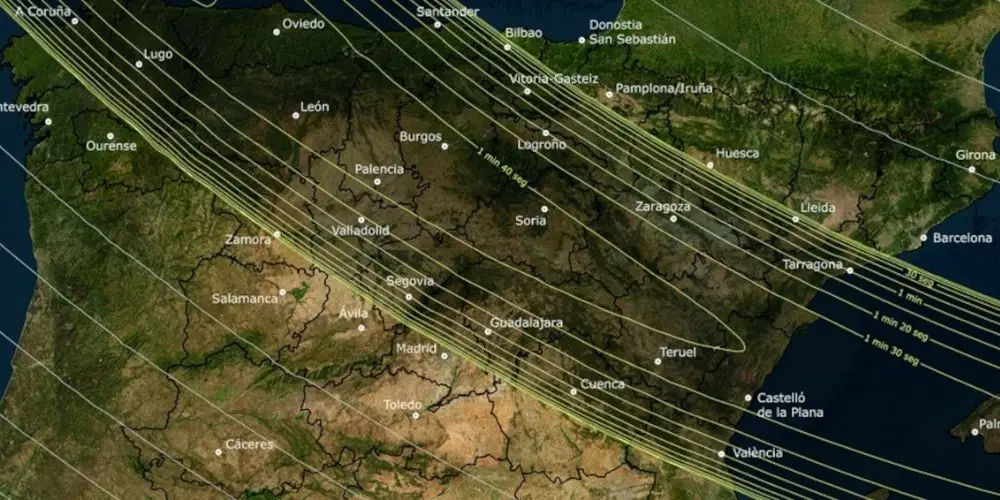
The path of totality crosses northern and central parts of Spain from Galicia towards the Mediterranean and then the Balearic Islands.
Among the provincial capitals within the totality zone are A Coruña, Oviedo, León, Bilbao, Zaragoza, Valencia and Palma de Mallorca. Other parts of the country, including much of southern Spain, will experience a partial eclipse instead.
For many Costa Women in Andalucía, therefore, the Sun will not disappear completely. It should still be an impressive sight, but there is one particularly important distinction:
If you are outside the path of totality, there is no point during the eclipse when it is safe to look directly at the Sun without proper eclipse glasses.
The Instituto Geográfico Nacional has an official eclipse visualiser where you can enter your location and check precisely what you will see and the timings for your municipality. Because the Sun will be very low in the sky, choose somewhere with a clear view towards the western horizon, without buildings, mountains or trees blocking the sunset.
What happens during a total solar eclipse? Step by step
One of the fascinating things about tomorrow’s eclipse is that it is not a sudden event. The changes build gradually before an amazing few moments around totality.
1. First contact
The eclipse begins when the edge of the Moon appears to touch the edge of the Sun.
At first the change will be tiny. Viewed safely through eclipse glasses, it may simply look as though someone has taken a small bite out of the Sun.
2. The partial eclipse grows
Over the following tens of minutes, the Moon covers more and more of the solar disc.
The daylight will gradually become unusual. However, it may remain surprisingly bright even when most of the Sun has disappeared.
You should look around as well as up. Shadows may become sharper and small gaps between leaves can project dozens of tiny crescent-shaped Suns onto the ground.
3. Light and temperature begin to change
For people inside the path of totality, the final minutes will become much more dramatic.
Light levels fall quickly. The atmosphere can begin to resemble a very late sunset, and there may be a noticeable fall in temperature.
Birds and other animals might react to the sudden change in light as if evening has arrived unexpectedly
4. Look for the diamond ring and Baily’s beads
Just before totality, the remaining sunlight can create two very unusual visual effects.
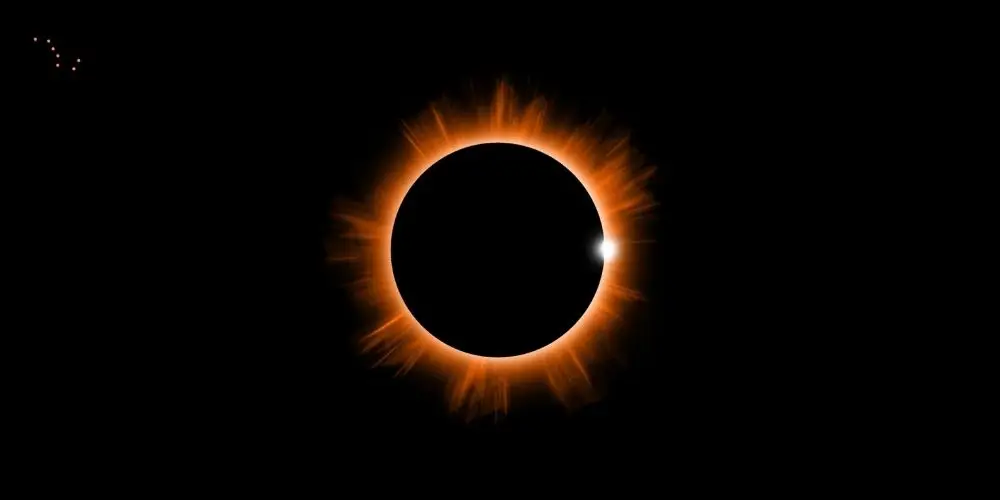
The first is the diamond ring, when one brilliant point of sunlight appears beside the dark Moon.
Then you might see Baily’s beads. These are tiny points of sunlight shining through valleys and irregularities along the Moon’s surface.
It is important to remember that protective glasses must still be worn while any direct sunlight remains.
5. Totality
Then, only within the totality zone, the Sun disappears completely.
The dark disc of the Moon sits where the Sun had been, and the normally invisible solar corona appears around it like a glowing halo.
Bright stars could become visible as the surroundings will darken dramatically.
This is the ONLY brief phase when eclipse glasses may be removed, and only if you are definitely inside the totality path and the Sun is completely covered. The moment sunlight begins to reappear, the glasses must go back on.
If you are watching a partial eclipse anywhere else in Spain, it is important to keep the glasses on throughout the full experience.
6. Everything happens in reverse
The first bright point of sunlight marks the end of totality.
Baily’s beads and the diamond-ring effect could appear again before the Moon begins to slowly move away from the Sun.
By then, however, Spain’s unusual sunset timing means the Sun will be extremely low on the western horizon, and in some places it will set before every stage of the eclipse has finished.
The most important thing is to protect your eyes
Ordinary sunglasses are not eclipse glasses. It does not matter how dark the lenses are.
Safe eclipse viewers should conform to the ISO 12312-2 international safety standard. Check your glasses before using them and discard them if the filters are scratched, torn or damaged. Children should be supervised.
And be particularly careful with cameras, binoculars and telescopes.
Do not look through an optical device at the Sun while simply wearing eclipse glasses. Cameras, telescopes and binoculars require their own specialist solar filters fitted correctly to the front of the equipment.
No eclipse glasses? A simple pinhole projection is a much safer alternative than improvising a filter.
Why Spain has activated a national command centre
The eclipse itself is predictable. The movement of millions of people is rather less so.
Spain’s Ministry of the Interior activated a Puesto de Mando Unificado – Unified Command Post – at the National Emergency Monitoring and Coordination Centre (CENEM) on Monday 10 August.
It brings together Protección Civil, the Secretaría de Estado de Seguridad, Policía Nacional, Guardia Civil and the DGT, monitoring conditions before, during and after the eclipse and coordinating the response to any incidents.
The DGT estimates traffic towards prime viewing areas could rise by 30% to 100%, generating between 400,000 and 1.5 million additional journeys. The biggest difficulty may come afterwards, when thousands of people attempt to leave viewing areas at approximately the same time.
Driving to see the eclipse? Don't improvise
If you can enjoy the eclipse from your own town or somewhere close by, the authorities recommend doing so.
If you are travelling, leave plenty of time, check the route beforehand and use public transport where practical.
Most importantly:
- Never stop on a road or hard shoulder to watch or photograph the eclipse.
- Park only somewhere suitable and permitted.
- Do not photograph or film the eclipse while driving.
- Never wear eclipse glasses while driving.
- Expect pedestrians and cyclists around popular viewing locations.
- Allow extra distance between vehicles and be prepared for sudden congestion.
- Consider waiting before travelling home rather than joining the immediate rush after totality.
That final point could make the evening even more memorable and worthwhile.
Don't rush home – the Perseids are coming
If you are somewhere safe and comfortable, Wednesday’s sky show does not have to end when the Sun disappears below the horizon.
The Perseid meteor shower should reach its peak around the night of 12–13 August, and this year conditions are particularly favourable because it coincides with a New Moon. Without bright moonlight washing out the sky, darker areas could provide excellent conditions for seeing shooting stars later in the evening.
Venus is another one to watch. It will be approaching its greatest eastern elongation on 15 August, making it particularly prominent in the western evening sky after sunset.
You may also have seen social media posts and videos describing a “six-planet alignment” on 12 August. There is a broader morning arrangement of planets around this period, but it is a separate pre-dawn event, not something produced by the eclipse, and several of the planets are difficult or impossible to see without optical equipment.
So for Wednesday evening, the easiest bonus plan is simpler: eclipse, sunset, Venus and then – if you can stay somewhere dark – the Perseids.
Wildfire risk is a serious part of the preparations
Large numbers of people heading into the campo or mountain areas during August create another potential problem.
AEMET’s special eclipse forecast says the wildfire danger on 12 August is expected to reach Very High or Extreme across much of mainland Spain and the Balearic Islands.
Protección Civil’s advice is straightforward: DO NOT light fires, do not park vehicles on dry vegetation, leave emergency access routes clear, take ALL rubbish home, and check the local fire-risk level before travelling into rural areas.
Mobile phone networks may also become saturated at particularly busy viewing locations. Therefore, it is worth having directions saved in advance and agreeing a meeting place with friends or family rather than relying entirely on your phone.
Will the weather cooperate?
The latest AEMET special forecast available on Tuesday morning is broadly encouraging.
Most of Spain is expected to have clear or mostly clear skies. There is greater risk of cloud along the Cantabrian coast and northern Galicia, with some uncertainty around the Alborán coast. Afternoon cloud could also develop around eastern mountain areas and parts of eastern Andalucía, while light calima may affect the Alborán Sea and the extreme south of Andalucía.
AEMET is updating its special forecast daily, so check again before setting off on Wednesday.
Quick eclipse checklist
Before you head out:
✓ Eclipse glasses marked ISO 12312-2
✓ Check your exact local timings on the IGN eclipse map
✓ Choose somewhere with a clear western horizon
✓ Check AEMET’s latest cloud and fire-risk forecast
✓ Take water – temperatures will still be high
✓ Park only in permitted areas
✓ Never stop on a road or hard shoulder
✓ Leave emergency routes clear
✓ Take all rubbish home
✓ Consider staying a little longer to avoid the traffic – and watch for the Perseids
Frequently asked questions
What time is the solar eclipse in Spain?
It takes place during the evening of Wednesday 12 August 2026, with the main phase across Spain occurring around sunset and maximum eclipse generally around the 8.30 pm period. Exact timings depend on your location, so use the official IGN eclipse visualiser rather than relying on one national time.
Can I see the total eclipse from everywhere in Spain?
No. Totality crosses a broad band from north-western Spain towards the east and the Balearic Islands. Elsewhere, including much of southern Spain, the eclipse will be partial.
Can I use ordinary sunglasses?
No. Use certified solar viewers conforming to ISO 12312-2. Ordinary sunglasses do not provide sufficient protection.
Can I photograph the eclipse?
Yes, but cameras, binoculars and telescopes require appropriate specialist solar filters. Never stop your vehicle on a road or hard shoulder to take photographs.
What happens after the eclipse?
The Perseid meteor shower reaches its peak around the same night, with excellent conditions thanks to the New Moon. If you are somewhere dark and safe, staying longer could also help you avoid the first wave of return traffic.
A very special night in Spain to remember
For most of us, this will be a once-in-a-lifetime experience.
Regardless of where you are in Spain, whether you´re standing inside the path of totality or watching the Sun turn into a brilliant crescent from southern Spain, take a few minutes to enjoy what is happening around you as well as above you.
Be prepared. Protect your eyes. Keep our beautiful countryside safe. And don’t hurry home if you don´t have it. Enjoy the experiences.
Wish upon a star!